
new sounds for woodwind
About two years ago, Sam Fairbrother from The Commission for New and Old Art called me to tell me he wanted to direct a production of Bow Down. Bow Down was written in 1977 by Harrison Birtwistle with text by playwright Tony Harrison, who died in September 2025. The piece is a retelling (in fact, several parallel retellings) of the ‘two sisters’ folk tale found in the Northern parts of the British Isles, Scandinavia and North America.I realised that I knew this story from the Andrew Bird song ‘Two Sisters’
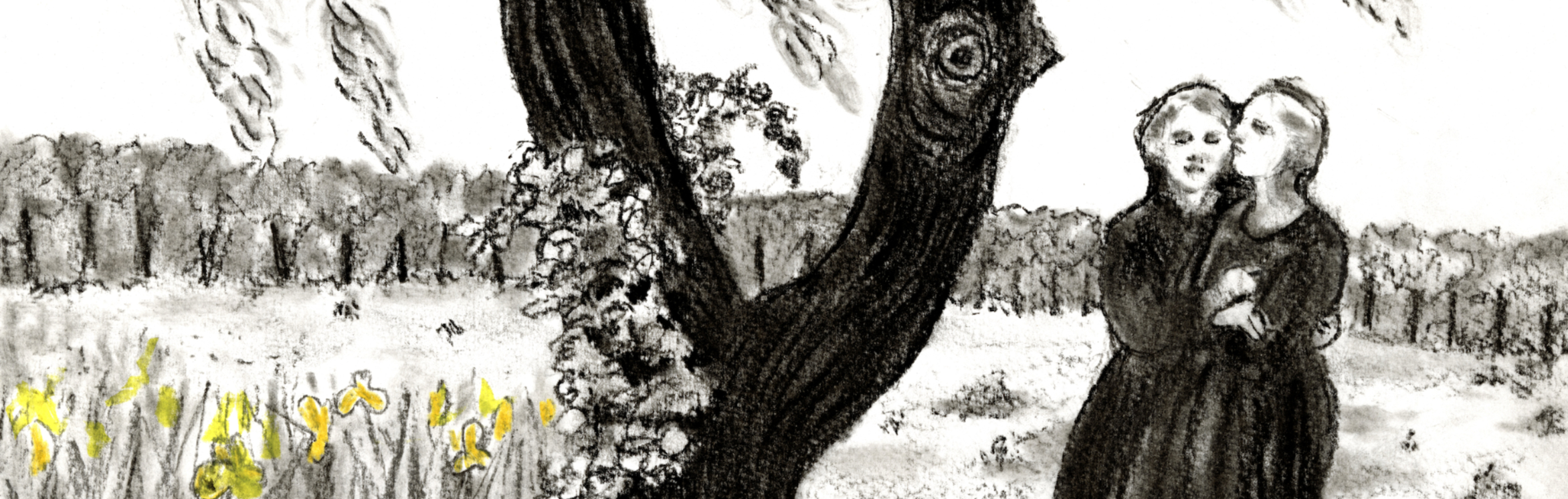 bow down poster by Sigrid Koerner
Two sisters (in the score, the ‘dark sister’ and ‘fair sister’) are in love with the same prince, the prince chooses one of the sisters to marry, and the other sister gets revenge by drowning her. A miller finds the body of the drowned sister and makes a harp from her bones and hair. When the harp is played, it accuses the remaining sister of murder. In this retelling, she is then buried alive – ordered by the harp with the haunting line “I drowned wet and you’ll drown dry”.
Bow Down is scored for flutes, oboes and a wide assortment of percussion instruments. Sam and I talked quite a bit about what it means to restage pieces from the 1970s, and the relationship between the ‘newness’ of some of the instruments as-was, and how they are experienced and heard now.As Sam put it – a lot of the percussion used in the original score used Afro-Latin instruments like claves, afuche and maracas that would have sounded very new to British audiences at the time, but since the 70’s have became a mainstay of British primary school musical instrument boxes
While making the Hedgehog I’d found a lot of resources on FM Synthesis, a technique that among other things is used to synthesise woodwind instruments. I’d got really excited about two documents: FM Synthesis of Real Instruments, that discusses FM techniques using the Yamaha DX7 to recreate different spectral patterns, and Bruno Bartolozzi’s book New Sounds for Woodwind. I was particularly taken with Bartolozzi, a book I’d found while writing a short essay about New Sounds. In the introduction, Bartolozzi directly credits the development of extended technique on woodwind instruments to the contemporaneous development of synthesisers:
“We owe to electronic music the revelation of a world of sounds unknown to instrumental music, at the moment when traditional instruments were considered to have reached the limits of their technical possibilities”
To an audience in the 70s, the sound of Bow Down would have felt really modern and revelatory, in part because of the instruments used. The conclusion we reached was that in re-enacting a performance of Bow Down for a contemporary audience (who have had 50 years to acclimatise to musical developments of the time), our ensemble should include instruments that feel new to us – machines. After some discussion, we decided that the ‘Woodwind Section’ of the ensemble could be comprised of a combination of natural and synthetic woodwind instruments, to be used somewhat interchangeably. These would be a synthetic flute (later the Flute Machine), and a synthetic oboe (the Haute Boîte).
In an early email where we were attempting to get some money for the project, I wrote the following:
We propose to construct a Woodwind Section by combination of traditional Woodwind Instruments alongside one or more machines, that would be programmed to produce Woodwind Sound.
We are interested in the material properties of Woodwind Sound, and thus interested in instruments that sit between the ‘natural’ and ‘synthetic’ in terms of their timbre and construction. An example of an instrument with such a sound is the Reyong, a traditional gamelan instrument, which is proposed to replace part of the percussion section. Synthetic things are often experienced as ‘too perfect’ — containing only clean or singular frequencies and vibrations. This experience is true both of audio taste, but also in other sensory dimensions — colour, flavour, scent.
making Woodwind Section
The core of the Woodwind Section development group consisted of myself, Lydia Philips (who also helped develop the synth for Valves) and Vasily Ratmansky. We also had some support from flautist Sam White and oboist Matthew Maroon, both based in New York, who played in the production. Throughout, we also had direction from Sam Fairbrother and extra synthetic thoughts from Austin Philemon.
Lots of the thinkinga collection of the references we used for this project may be found here about the machines boiled down to a discussion of what the ‘essence’ of flute and oboe sound is. Through working with John Richards I’d become really convinced that electronic instruments shouldn’t have too many different buttons and dials on them – there’s an impulse to control all the aspects of a sound that comes with electronic music and I was determined to resist that. The problem then becomes translating the expressiveness of an analogue instrument into a relatively terse set of inputs.
lydia attempts a duet with oboist Nicholas Daniel using a very early prototype. It sounds a bit like Clanger in the higher registers, an issue I eventually resolved by scaling the addition of noise with pitch.
I remember quite clearly a couple of phone calls with Sam and Lydia early on, where we decided that the essence of oboe-sound has two essential qualities:
- manipulating sound through embrochure (lip) pressure
- distinctive articulation (t-sound/p-sound) at the start of notes
Flute-sound was a little less well-defined (I’m not a flutist), but boiled down to:
- potential for big vibrato
- expressive manipulation of volume
We further determined that while the oboe needed often to be totally silent (and true to a real oboe, should have minimal volume control), the flute could play a much more textural role, provided that wasn’t its only function. From these constraints, the Flute Machine and Haute Boîte were born.
After about a year of slowly accumulating people and ideas (but no funding), and very slow instrument development, The White Hotel called up Isaac and Lydia to say they wanted to stage Bow Down as part of the Black Lights festival in Blackpool, at the end of June 2026.
Haute Boîte
Of the two instruments, the haute-boîte was by far the more challenging to make. Initially, I’d considered using an analogue synth to make the sound, but realised that if I wanted to use FM synthesis then I’d be better off using a digital approach, that would allow me to be more flexible later on. I started out by adapting some of the basic examples from van Hunter Adams’ fantastic lab notes on Direct Digital Synthesis for the RP2040 microcontroller. Using a similar approach to the hedgehog code, I added FM to a simple sine tone example, pushing the harmonics around until I got something that sounded a bit woodwind-y.
A lot of the work in emulating instruments also comes with shaping the envelope of the sound. This is particularly important with the oboe, as the start of the note comes with a very distinctive kind of articulation. Notes on an oboe are formed through three stages – first, the tongue is placed onto the reed. Then, the embrochure creates pressure around the reed, and you begin blowing. To start the note itself, the tongue is then removed – depending on the softness or hardness of the removal and the shape of the embrochure, the start of the note will have a harsher t-sound, or a softer p-sound.
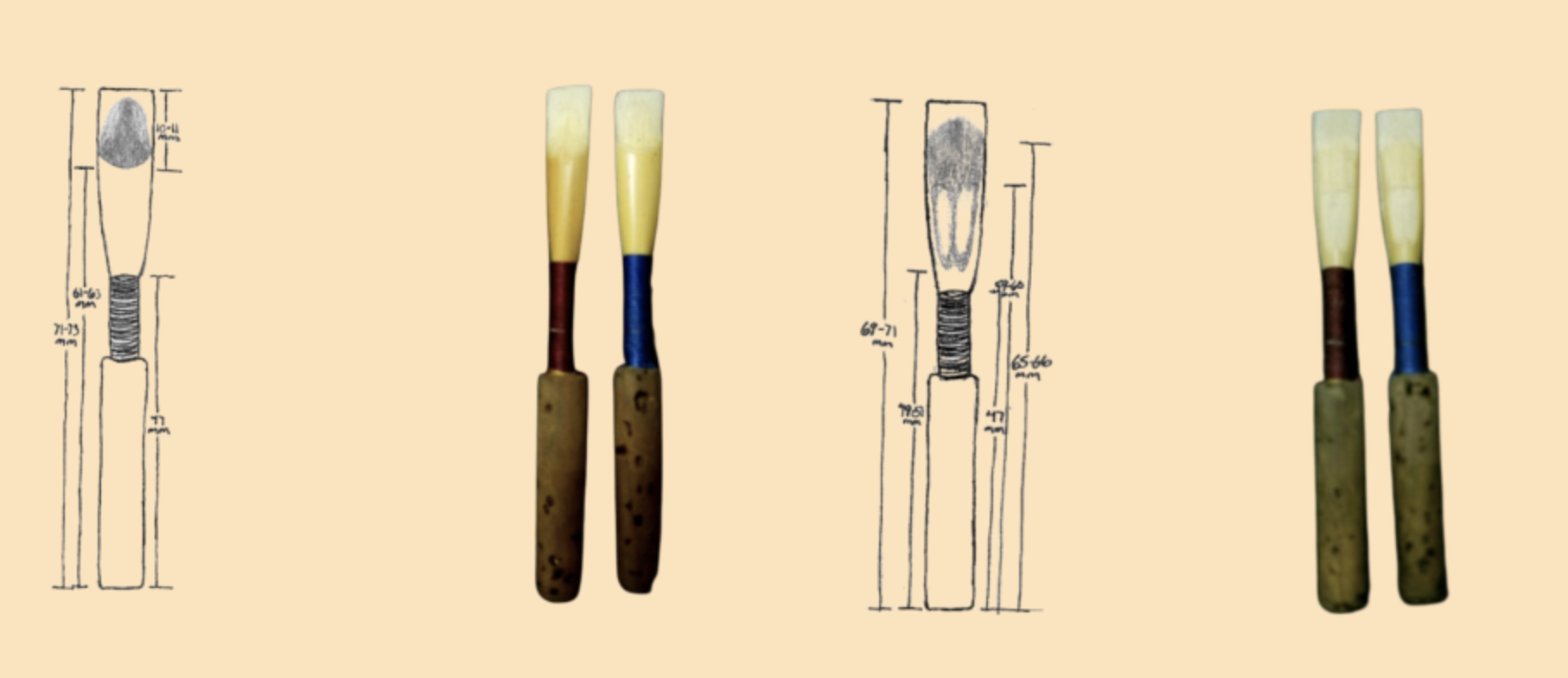 comparing british (left) vs american (right) oboe reeds
choosing sensors
In translating my experiences of playing the oboe into electronic form, I came up with a somewhat simplistic theory of the instrument: “oboe sound is determined by lip pressure”. A complicating feature is that this view is actually quite specific to European oboe technique. I found through talking to Matthew that American reeds have a much longer scrape, and allow more air to move through than their British equivalents, typically requiring less manupulation with the embrochure than European reeds.
I toyed with the idea of using an airflow sensor for the . I’d come across a fantastic electronic woodwind instrument made by an artist called ???, called Centikhene, which used a wind sensor developed by a different synth artist called Ian Fritz. It works by optical sensing – the breath moves a diaphragm, which in turn modulates light from an LED falling on a phototransistor, a signal that is then amplified.
In the end,
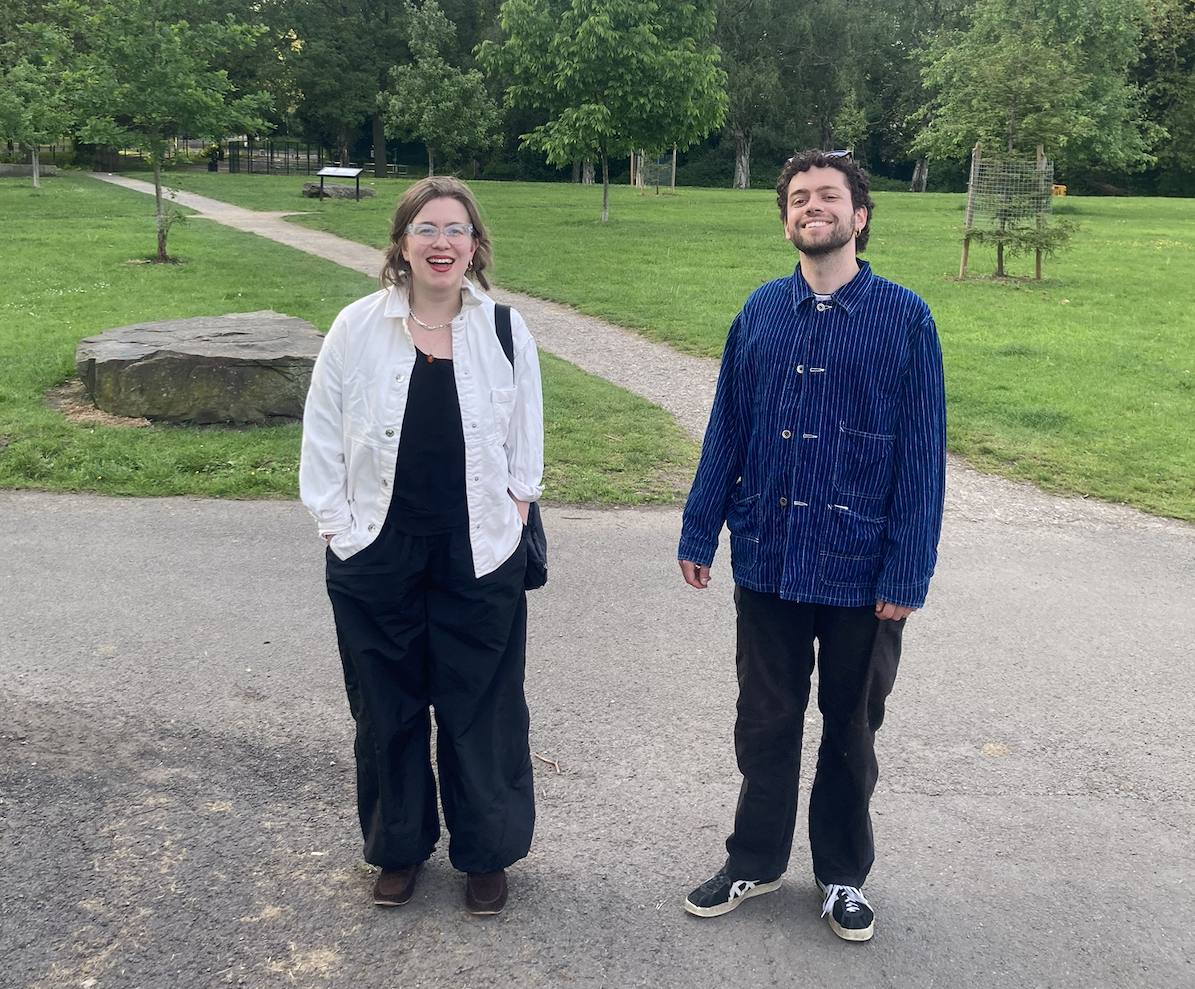 Vasily and Lydia in Cringle Park
Vasily, Lydia, Sam and I met in Manchester in May to rehearse with the prototype instruments. The weekend was really intense – the only photos I have were from a short break we took to go to the park.
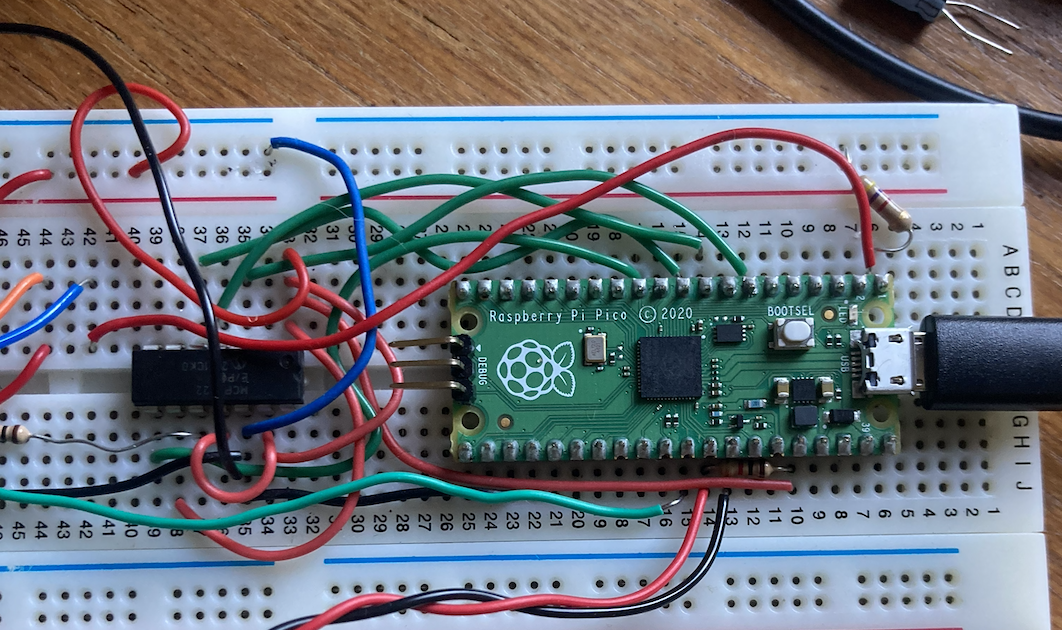 extremely mangled early haute-boite breadboard prototype
matthew maroon
austin
vibrato
envelope – getting the decay right
RP2040
van hunter adams code
reediness – want to work more on modulation with pitch
hot dog stand Vasily
mounted speakers
Flute Machine
The Flute Machine started life as a barely-tweaked demo of FM synthesis I’d made for my students out of an old hedgehog prototype. It uses an STM32 microcontroller, and has two dials – one varies the pitch of the carrier wave, and another a modulating frequency. When you increase the frequency of the modulating wave past that of the carrier wave, you move from a wobbly vibrato into a beautiful, ringing range of multiphonics.overjoyed recently to learn that the German word for multiphonics is Mehrklänge = ‘more sounds’ Depending on the ratios between the two waves, you get a nice range of wobbles, bell-like and flute-like sounds, plus some crunchy things on the top end.
I’d taken this to Sam White on a visit to New York in Summer 2025, and we had a go at playing through some of the score for Bow Down as a kind of shaky duet. It was a nice proof of concept for the instrument, and after some tweaks, I tested it with Lydia in early 2026, as an afterthought to a meeting that was almost entirely dominated by the haute-boite.
The main innovation of the flute machine was actually in the volume control. I’d modded the hedgehog board to include a volume dial, but inspired by the ‘reed control’ used for the haute-boite (more below), I tested adding a pressure sensor in parallel across the top two pins of the potentiometer on the output. Pressing the pedal pushes the output voltage up toward the top rail, swelling the sound in a really interesting, expressive way. This was quite revelatory – it felt like a bit of a missing piece of a machine that had hitherto felt a bit flat.
peace, newness and machines
In some ways, our discussions of the synthesisers and ‘new’ sounds feel like a development from the Valves synthesiser, where we
Recently, at the Quaker meeting I attend, one of the elder members gave a talk after meeting about what she considered to be ‘revolutions’ that had occurred in the quaker faith at different points.
Radical nature –
Some of the elders were talking afterwards, and were talking about how in contrast to a lot of other points in the faith’s
Other Notable New Sounds
vasily 3d printed reed
oboe reed in trombone very good
Trombassoon
Vasily feedback sounds
birdsong for the students
While I was working with the RP2040 adapted bird sounds for arduino